

Dentures – West Orange, NJ
An Affordable Way to Replace Your Teeth
Losing multiple teeth can make speaking and chewing very difficult, and having a noticeable empty space in your grin can hurt your confidence. You’ll naturally want to have all of your teeth replaced as soon as possible, and oftentimes the best way to do that is with a customized denture. Dr. Dawoud and Dr. Gencarelli are proud to offer full and partial removable dentures in West Orange as a way to re-complete your smile. To learn more about this tooth replacement option, contact our team at D&G Dental of West Orange today.
Why Choose D&G Dental of West Orange for Dentures?
- Specially Designed for Every Patient
- Removable & Fixed Options Available
- Made to Look Natural & Last a Lifetime
Who’s a Good Candidate for Dentures
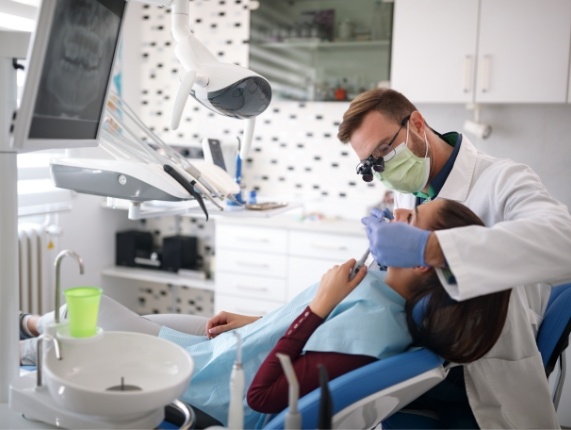
You may be considered a candidate for dentures if you have suffered from extensive tooth loss. That said, you need to have enough healthy gum tissue and jawbone structure to support your new teeth; if you don’t, you may need to undergo preliminary treatments, such as bone grafting, before you can receive dentures. Our team will perform a thorough exam at your initial consultation to confirm that dentures are the right choice for your smile.
Effects of Missing Teeth
Tooth loss can have a significant effect on your well-being. According to the American Academy of Periodontology, there are various negative consequences of missing teeth. They include facial sagging, difficult speaking, challenges while eating, and low self-esteem. When you replace your missing teeth with dentures, you can improve all of these areas and your quality of life.
What Qualifies You for Dentures?
Dentures are ideal for those who are missing multiple teeth. Depending on the number of teeth you are missing and where they are located in the mouth, we can put together a custom treatment plan to meet your needs. The main qualification that you need to meet being in good oral health. This means that if you have existing oral health issues, like tooth decay or gum disease, they need to be addressed and eliminated ahead of time. After your existing teeth and gums are in good condition, we can move forward with the rest of the process.
Alternative Tooth-Replacement Options
If dentures don’t interest you, there are various other solutions available that may be a better fit. Here are some of the ones that we offer.
- Dental Bridge: A dental bridge works by “bridging” the gap in your smile with a replacement tooth. The replacement tooth is called a “pontic,” and it is supported to by two dental crowns that are placed on the adjacent teeth.
- Dental Implants: A dental implant is a titanium, screwlike post that is surgically inserted into the jawbone to support a replacement tooth. With means that you must have a strong enough jawbone to support healthy implants. Dental implants have a higher upfront cost, but they are made to last for upwards of three decades or even the rest of your life!
Types of Dentures
There are three main kinds of dentures that might be recommended to you depending on how many teeth need to be replaced and how healthy your jawbone is. Below is a brief overview of your options:
Partial Dentures
A partial denture is recommended if you only need to replace some of the teeth in a single arch. The restoration is comprised of a gum-colored base and a number of prosthetic teeth; it will be designed to fit perfectly in the spaces in your smile, and metal clasps will be used to attach it to your natural teeth. Once it’s in place, most people won’t be able to tell the difference between your prosthetic and the rest of your grin.
Full Dentures
We will recommend a full denture if you’ve already lost all of the teeth in a single arch or if you don’t have enough healthy teeth that are worth saving. A full denture consists of a gum-colored base and a full row of prosthetic teeth. Your restoration will rely on natural suction to stay on your gums; if you want to give it some extra stability, you can apply an adhesive specially designed for dentures.
Implant Dentures
Dental implants can be surgically placed in your jaw to support a partial or full denture. This prevents your dentures from moving when you don’t want them to, and the added stability will make it easier to chew all of your favorite foods.
Learn More About Implant Dentures
How Dentures are Made
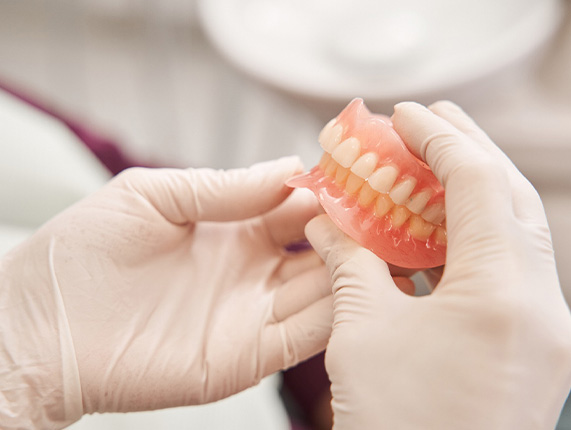
Some patients are surprised to learn that it can take a couple of weeks for their dentures to be designed and delivered. However, the wait time is largely due to the fact that your restoration is carefully customized to fit like a glove and resemble your natural teeth and gums.
Understanding how your dentures are made can help you appreciate your new teeth that much more. Continue reading to learn more about the process, and please don’t hesitate to contact us if you have additional questions.
What are Dentures Made Of?
This is the tried-and-true solution for tooth loss because it’s a versatile way to restore your smile’s functionality and appearance. Their two main components are the gum-colored base and the artificial teeth, outlined with more information below:
- Denture base. This is the foundational structure that gives your restoration its shape, and can be made from various options, such as nylon, porcelain, or resin, but acrylic is the standard selection.
- Pontics (artificial teeth). The teeth themselves are usually made from resilient porcelain that reflects light like enamel and can be made to match the shade, hue, and size of the teeth that went missing.
The Denture Creation Process
The process might vary slightly depending on your unique circumstances, but typically, designing and building your one-of-a-kind dentures in West Orange involves the following steps:
Step #1: Our team will make impressions of your teeth and gums to create a replica of your mouth, which is used to ensure your restoration fits like a glove.
Step #2: The cast is sent to a dental laboratory along with scans and images, and a technician uses them to start building a wax gumline for your new teeth.
Step #3: Artificial teeth made from acrylic resin are set into the gums using a device called an articulator. Then, the tech will shape and carve the wax to look more lifelike.
Step #4: This wax version of your dentures is returned to our office so we can schedule an initial fitting for you. At your appointment, we’ll note any necessary adjustments and send your restoration back to the lab for completion.
Step #5: To remove the wax portions while retaining the shape of your dentures, they’re placed in a flask, and then plaster is poured in. Once it hardens, the container is placed in hot water to melt the wax away.
Step #6: Holes are made in the teeth to be placed, and a liquid separator is included in the plaster to prevent acrylic from clinging to areas it shouldn’t. Then, acrylic is injected to replace the wax portions.
Step #7: The plaster is carefully removed, and your now-acrylic dentures are placed in an ultrasonic bath for a thorough cleaning.
Step #8: Excess material will be trimmed away and your restoration will be polished to perfection.
Step #9: Once our team receives your completed dentures, we’ll contact you to schedule a final fitting to ensure everything fits and functions as intended. If it all checks out, we can send you home with your beautifully rebuilt smile!
Adjusting to Your New Dentures
It’s normal to feel sore when you first start wearing dentures regularly, and it often takes patients about a month to fully acclimate to their new teeth. You can ease this transitional period by sticking to softer foods at first, to avoid triggering the tender tissues in your mouth.
You might also develop a temporary lisp, a slur, or other change in your speech patterns, but thankfully, most people can overcome this with enough time, practice, and patience.
Getting Used to Your New Denture
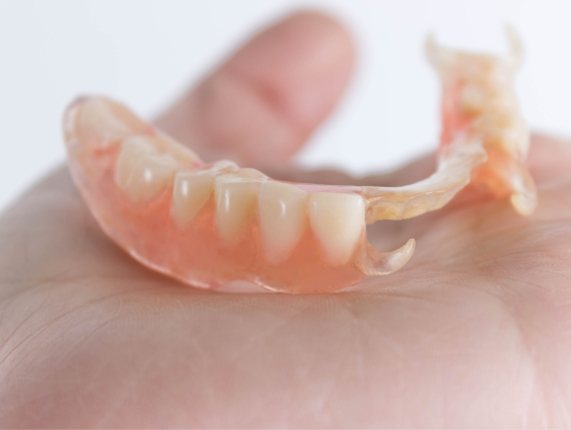
It may take some time to adjust to your denture, especially if you have been without teeth for a while. You may have excessive saliva build-up as your mouth gets used to the new prosthetic. Eating may seem difficult at first, and you might have trouble saying certain words. Don’t worry – these are all common side effects of a new denture. Make the adjustment easier by cutting your food into small bites and sticking to softer meals at first. Practice reading out loud to yourself to retrain your speech habits. And most importantly, wear your denture all the time (except at night) to speed through the adjustment phase.
The Benefits of Dentures

Losing many teeth can make many daily tasks like eating, speaking, and smiling incredibly frustrating, but dentures from D & G Dental of West Orange can be an excellent way to restore the appearance and function of your grin. Here’s a quick look at how these marvelous restorations can improve your quality of life after tooth loss.
Psychological Benefits
It can be difficult to accept losing many or all of your teeth, and many people with compromised smiles find it difficult to engage socially and may experience sadness, isolation, and depression. Restoring your smile with gorgeous dentures from D & G Dental of West Orange can make it easy to smile proudly at work and at social events and help you feel confident in your appearance, speaking ability, and chewing ability.
Clearer Enunciation
Tooth loss can alter the way sound moves through the mouth during speech since the lips and tongue must be properly positioned to form certain sounds and words. Since dentures function in the place of your missing teeth, they can make it much easier to speak clearly. After you get used to wearing your dentures, you should find that speaking becomes increasingly easy.
Improves Nutrition
Losing teeth can make it difficult to eat many nutritious foods like fresh meat, raw fruits and veggies, and crunchy nuts and seeds. Dentures can restore much of your chewing power, which can make it much easier to enjoy the diverse diet full of interesting flavors and textures your body needs to stay healthy and strong. This can also help a person chew thoroughly and set them up for smooth and comfortable digestion.
Preserves Oral Health
Tooth loss can expose the gums to injuries, cause excessive enamel wear by redistributing the pressure of chewing, and lead to dental drift that makes it easier to develop oral infections. Dentures can shelter the gums, help the patient chew evenly, and reduce dental drift, allowing you to keep your mouth healthy and preserve your facial structure.
Expands Opportunities
Your smile is an important asset in the social and professional worlds, and not being proud of your grin due to tooth loss can make it difficult to meet people, leave positive first impressions, or move forward in your career. Restoring your smile with dentures can make it easier to win trust, build rapport, make friends, and close sales, and it can even help you stand out from the competition when being considered for a new job by giving you a gorgeous smile. In this way, your restoration may end up paying for itself.
Understanding the Cost of Dentures
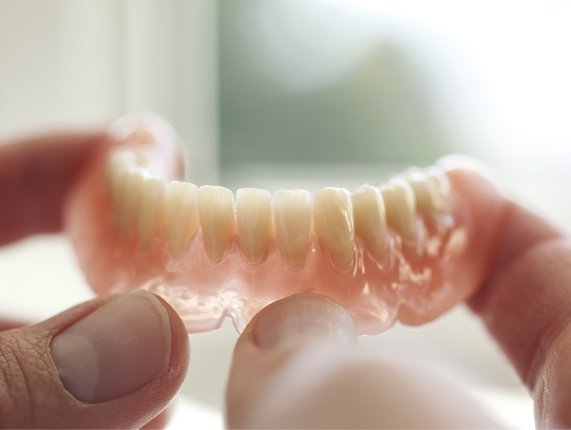
Dentures are attributed to a large price tag, but they are more affordable than you might realize. At D&G Dental of West Orange, we believe your financial situation should never stand in the way of replacing your lost teeth. Many factors affect the cost of dentures in West Orange, but we have the solutions you need to keep a complete smile within your budget.
Factors That Affect the Cost of Dentures
A one-size-fits-all denture would be uncomfortable and aesthetically unpleasant, which is why there’s no flat fee for a new set of teeth. Several things will affect the amount you'll pay, like:
- Preparatory Treatments: It’s not uncommon to require a little prep work, like tooth extractions or gum disease treatment.
- Number of Arches: Treating both the upper and lower teeth will cost more.
- Type of Denture: You have multiple prosthetics to choose from, like traditional dentures, palate-less options, and implant dentures.
- Materials: Discounted materials may cost less, but they may not be as comfortable, durable, or aesthetically appealing.
Your denture dentist in West Orange will examine your mouth and learn more about your preferences to create a personalized treatment plan. You'll know exactly how much your new smile will cost before committing to anything.
Are Implant Dentures More Expensive?
Implant dentures may be more expensive upfront, but they are the most cost-effective long-term because they can last for decades with the right care. You won't have to budget for replacements every few years like you would with traditional dentures. Not to mention, the implant denture process is performed in several steps over many months, which gives you more time to pay, so you won't have to come up with a lump sum.
Does Dental Insurance Cover Dentures?
It's unlikely your dental insurance will cover the entire cost, but you can use your benefits to lower the amount you’ll pay for certain steps in your plan, like your consultation, preparatory procedures, or your prosthetic. A member of our team will work on your behalf with your dental insurance to maximize your coverage to reduce the amount you’ll pay out-of-pocket. They’ll explain how your benefits are being used and discuss any remaining balance.
Other Options for Making Dentures Affordable
Besides using your dental insurance, our office offers many solutions to keep dentures in West Orange affordable, including:
- Traditional Payments: Our office accepts all traditional payment methods, including cash, checks, and credit cards.
- Specials: We offer regular promotions, like a free dental implant consultation.
- Monthly Payments: You can pay any out-of-pocket expenses using a monthly payment plan through a third-party financing company, like CareCredit. You can enjoy little or no interest in financing based on your credit approval.
It doesn't have to cost you an arm and a leg to replace your lost teeth. We'll help you find the financial solutions you need to invest in a high-quality, durable denture that closely mimics your real teeth. If you're ready to rebuild your smile or have questions about your payment options, contact our office today.
Denture FAQs
Dentures in West Orange have been used for generations to treat significant tooth loss in one or both arches. Although they are a tried and proven method of replacing lost teeth, it’s normal to have some concerns before you’re ready to invest in them. Your dentist at D&G Dental of West Orange will explain everything during your denture consultation. While you wait for your appointment, here are the answers to a few frequently asked questions.
Can I sleep with my dentures in my mouth?
Initially, your dentist will instruct you to wear your new dentures for 24 hours. After the first day, get in the habit of taking them out before going to bed. Although no one wants to be caught without their teeth, your oral and general health relies on the nightly removal of your dentures because they will restrict blood circulation to your gums. If your soft tissues aren’t given time to recuperate, it can lead to sores, inflammation, and infections. Not to mention, your mouth is a hotspot for oral bacteria growth at night, which can lead to odors and shorten the lifespan of your dentures if they aren’t taken out nightly. It’s best to remove them and place them in an overnight soaking solution to combat harmful bacteria. It will also keep them moist to prevent them from warping while you get the rest you need.
Does an upper denture always cover the palate?
Concerns about an upper denture covering the roof of the mouth aren’t uncommon. If you’re worried about discomfort or an upper denture changing the way food tastes, you have other options, like a prosthetic shaped like a horseshoe. Your denture dentist in West Orange will review all your options to help you make the right choice for your needs, preferences, and comfort.
Can I use regular toothpaste to clean my dentures?
Although your dentures will closely look and feel like your real teeth, they can’t be cleaned the same way. Abrasive dental products can scratch your dentures, tarnishing their appearance. Bacteria and food particles can also get trapped in the small crevices, leading to odors and damaging your denture. It’s best to skip toothpaste when cleaning them. Instead, use a soft-bristled toothbrush and mild hand soap or dishwashing liquid. You can also purchase cleaning kits designed for denture wearers. Besides brushing your dentures, don’t forget to use a nightly soaking solution to remove any bacteria or plaque left behind by your toothbrush.
Is a broken denture a dental emergency?
Yes, broken dentures are a dental emergency because you rely on them to get through the day. Never use superglue or try to repair them yourself. Instead, leave the mending to professionals. Contact our dental office for an appointment and use an old denture if possible. Don’t continue to wear your denture if it’s broken because it can lead to oral injuries and additional damage. We will get you into the office quickly to provide the necessary repair or replacement.